The 2025 Hennessey Report confirms what we’ve been seeing in Northwest North Dakota: this is not a crash. It is a mature, fundamentals‑driven normalization. Fewer homes sold, but prices held, and in several key segments they quietly pushed higher. That is exactly the kind of environment where informed buyers, sellers, and investors can make their most strategic moves.
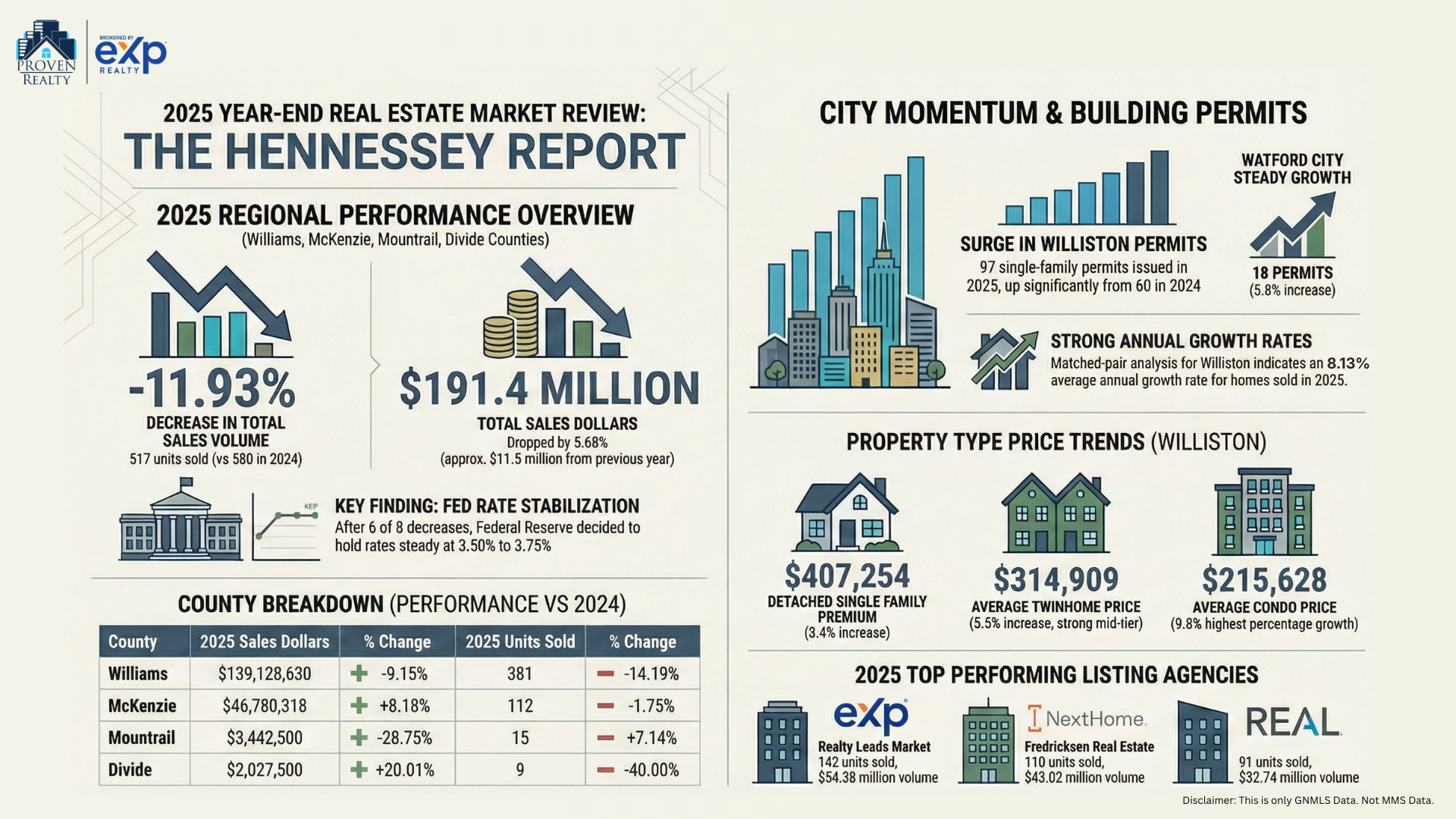
Across Williams, McKenzie, Mountrail, and Divide Counties, total residential sales dropped from 2024 to 2025 by nearly 12 percent in unit count. Yet total dollar volume only slipped a little over 5 percent. When the number of sales falls faster than the total dollars, it usually means this: activity slowed, but values did not unravel. The market took a breather; it did not break.
Average sale prices across the four‑county region moved into the high 300‑thousand range, and the average sale‑to‑list ratio stayed just under 97 percent. In plain language, most homes sold within a narrow band of their list price. Days on market actually improved slightly year‑over‑year. This is what stability looks like: fewer deals, but solid pricing and reasonably efficient absorption.
For buyers, this means waiting around for deeply discounted “crash” pricing is likely a losing strategy. For sellers, it means you don’t have to panic or slash your price to move your property, but you do have to price in line with current reality instead of last year’s wishful thinking.
County‑Level Story: Different Lanes, Same Highway
The Hennessey Report breaks down each of the four counties, and the differences matter.
Williams County, anchored by Williston, remains the core of the market by both units and dollar volume. It saw a decline in total dollar volume from 2024 to 2025, but it still accounts for the majority of transactions in the region. McKenzie County, on the other hand, quietly posted an increase in total sales dollars, with average prices topping the 400‑thousand mark. That’s real resilience in a smaller, energy‑anchored market.
Mountrail and Divide Counties showed percentage swings that look dramatic on paper—but they are also much smaller samples. In practice, that means more volatility and more nuance. These markets can offer value and opportunity, but they require sharper local insight and more careful exit planning.
If your goal is stability and scale, the Williams and Williston area remain your primary lane. If you want growth with resilience and are comfortable operating a bit more “up the road,” McKenzie deserves serious attention. If you are an opportunistic buyer or investor willing to accept thinner liquidity in exchange for price or yield, targeted plays in Mountrail and Divide can make sense, but you should not go into them blind.
Williston and Watford City: Builders Are Quietly Bullish
One of the most telling signals in the 2025 Hennessey data is building permits, especially in Williston and Watford City. Builders and lenders are usually the first to retreat when a market is in trouble. In 2025, they did the opposite in key locations.
In the City of Williston, single‑family permits jumped from 60 in 2024 to 97 in 2025. Williams County outside the city added another meaningful batch of permits, and Watford City continued to show steady single‑family permit activity as well. Builders do not dramatically ramp up production in markets they believe are headed into decline. They invest where they see durable demand, a solid wage base, and the ability to exit their product.
For you, that means two things. First, new‑build corridors in Williston and Watford City are likely to remain important engines of future comparables and appreciation. Second, you still need selectivity. Within the same city, neighborhoods can perform very differently depending on builder reputation, infrastructure, school access, and surrounding development plans.
Product Types: Where the Real Growth Is Hiding
The Hennessey Report also breaks out performance by property type, and that is where savvy buyers and investors can pick up an edge.
In Williston, detached single‑family homes continued their long‑term upward trend, with average prices rising again in 2025. Twin homes also moved higher, posting mid‑single‑digit percentage gains. Condos actually showed some of the strongest percentage price growth of all, while townhomes gave back a little after a very strong 2024.
Most consumers ask, “Are prices up or down?” The sharper question is, “Which product type is gaining momentum, and which is cooling off?” Detached homes remain the backbone of the market: liquid, desirable, and appreciating. But the data suggests condos and twinhomes deserve more attention from first‑time buyers and small investors. They often offer a more accessible price point while still tracking the broader positive trend.
If you are stretching to get into your first home, a well‑located condo or twinhome can give you a foothold in the market without over‑leveraging yourself. If you are an investor, you should be looking at segments where prices are rising, days on market are reasonable, and financing remains widely available. Those are the product types most likely to attract the next buyer when you decide to exit.
Financing, Rates, and Why 2026 Matters
The financing breakdown in the Hennessey Report is another sign of a healthy, fundamentals‑based market. The majority of volume is being done with conventional loans, followed by a large share of FHA financing and a meaningful VA presence. Cash buyers and non‑traditional structures make up a smaller portion of the total.
That mix tells us the market is being driven by real households and qualified borrowers, not just speculative cash. At the same time, interest rates have come off their recent highs. After several cuts, benchmark rates are at their lowest levels in nearly four years and have stabilized. Historically, in the Bakken, confidence tends to return once rates stop climbing and start leveling off. Activity then rebuilds with a lag.
For buyers, that means you are in a rare window where you can still negotiate and secure favorable terms before the next demand wave fully materializes. For sellers, it means that pricing correctly into this environment can allow you to exit at strong numbers while capturing renewed buyer interest driven by better affordability.
The risk many people miss is waiting too long. If you hold out for slightly lower rates while prices and competition move up faster, you can end up paying more overall, even if your rate is marginally lower.
Where Proven Realty and Erik Peterson Fit Into the Picture
The Hennessey Report is one of the most trusted sources of housing data in our region because it is built by hand from GNMLS closed sales and intentionally filters out most of the noise. But the report is only the starting point. Turning those numbers into strategy is where Proven Realty North Dakota adds real value.
Erik Peterson, founder of Proven Realty, has negotiated hundreds of millions of dollars’ worth of transactions throughout the Bakken, across residential, commercial, industrial, workforce housing, and development. He is not just a broker; he has been an operator and investor in multiple Bakken‑based businesses. That background matters because it means we interpret Hennessey’s charts through the lens of real operations on the ground: job growth, employer plans, logistics, and infrastructure.
As a boutique brokerage focused on Western North Dakota and Eastern Montana, Proven Realty is built to operate where the Hennessey Report is most relevant: Williams, McKenzie, Mountrail, and Divide. Our approach combines local relationships, off‑market visibility, and data‑driven analysis. We use the report to benchmark fair value by county, city, neighborhood, and product type; then we overlay what we see in current showings, offers, appraisals, and builder activity.
Our bias is clear: we believe Western North Dakota is a fundamentals‑driven region anchored by real industry, real income, and attainable housing. The 2025 Hennessey data backs that up. We see stable pricing, renewed building permits, and strength in entry‑level and mid‑tier product—not the hallmarks of a distressed market.
Turning the 2025 Hennessey Report Into Your 2026 Game Plan
If you are a buyer, your next step is to decide which lane you want to be in: stability and scale around Williston, growth with resilience in McKenzie, or targeted opportunities in smaller counties. Then you match that choice with the right product type and financing, using the report’s numbers as guardrails.
If you are a seller, you should be using this data to price correctly from day one. Properties priced into the actual 2025 trend are still selling near list price. Those priced as if it were a very different market are the ones sitting and chasing.
If you are an investor, you should be building a clear buy‑box: acceptable price ranges, days‑on‑market thresholds, and minimum rent‑to‑value ratios, informed directly by Hennessey’s county and city breakdowns. From there, it becomes a matter of sourcing deals that fit—and knowing when to walk away from those that do not.
At Proven Realty North Dakota, this is exactly how we work with Hennessey’s report every year. We take the data, connect it to what we are seeing on the ground, and help you convert it into specific, confident decisions—whether that means buying, selling, holding, or repositioning.
To review the full 2025 Hennessey Report and then talk with us about what it means for your property, neighborhood, or portfolio, you can access the report here:
https://drive.google.com/file/d/1FIU52qgc6mFtBEVgZ6k3bVO0uuVJaeyw/view?usp=sharing